

When the Spectrum Collapses
Complexity, Cognition, and the Limits of Containment

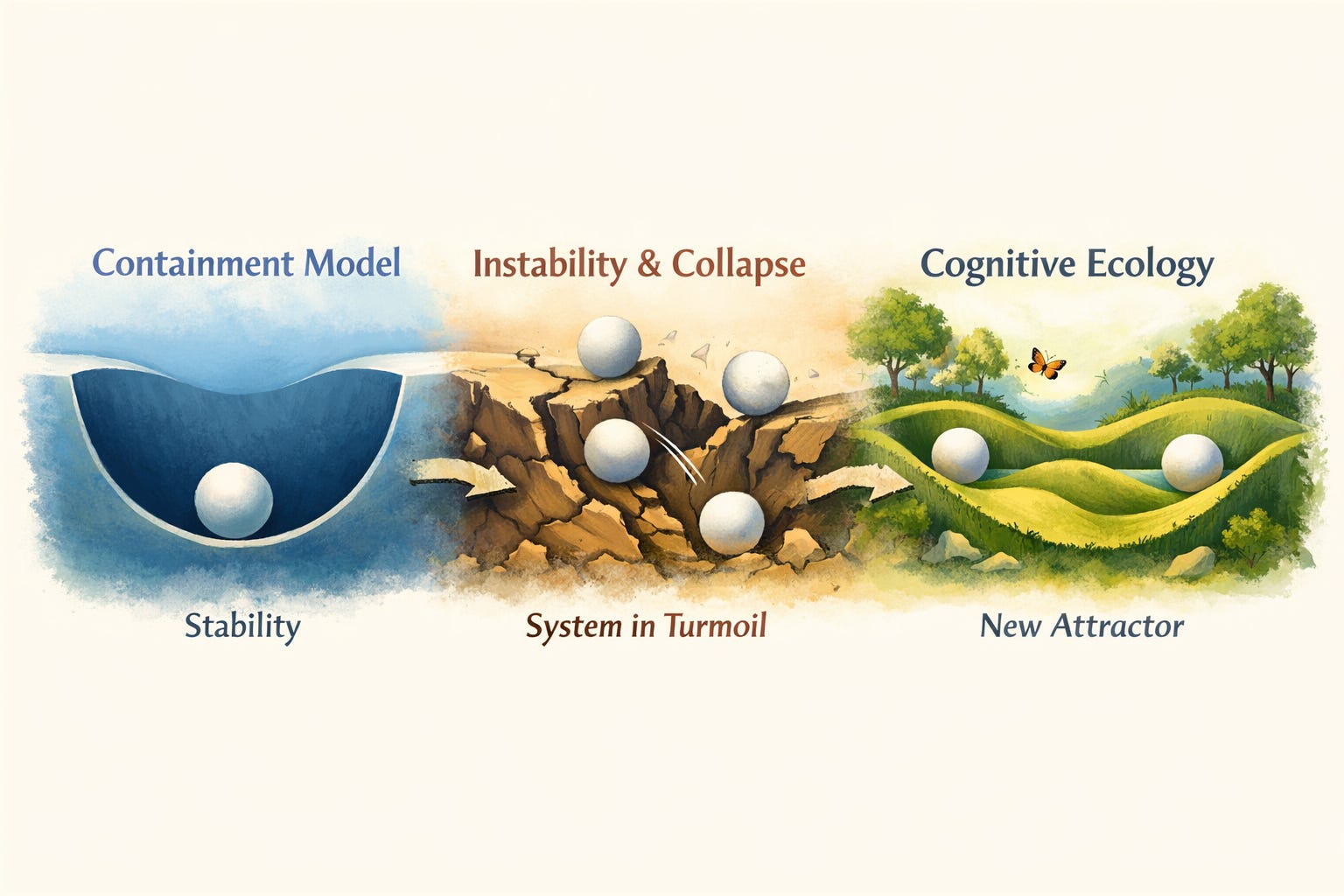
Complex systems stabilize around attractors—patterns maintained by feedback loops. As variation accumulates, these attractors weaken. Instability increases until the system reaches a critical transition and reorganizes into a new structure.
Author’s Note
This essay was prompted by a recent interview with developmental psychologist Uta Frith, published in The Telegraph (March 2026), in which Frith suggested that the concept of the autism spectrum may have expanded so broadly that it risks losing diagnostic coherence.
Frith’s work has played an important role in shaping contemporary scientific understanding of autism, particularly through early research on cognitive development and social cognition. The reflections offered here are not intended as a critique of any individual researcher. Instead, they examine the broader conceptual frameworks within which autism has historically been studied.
The argument presented in this essay is that the apparent instability surrounding the autism spectrum may not indicate that autism itself has become meaningless. Rather, it may reveal the limits of the containment-based models of cognition within which the spectrum was originally developed.
From the perspective of complexity science, such moments are not unusual. They are often the point at which an existing framework begins to reorganize under the pressure of new information.
Before We Begin
When scientific concepts begin to collapse under the weight of their own complexity, the instinct is often to tighten definitions and restore order.
But in complex systems, collapse rarely marks the end of a concept.
More often, it marks the moment when the model used to describe a phenomenon can no longer fully contain the complexity it helped reveal.
The current debate surrounding the autism spectrum may represent such a moment.
Over the past several decades, the category of autism has expanded dramatically. Experiences that were once considered unrelated—differences in sensory perception, social processing, pattern recognition, and emotional regulation—have increasingly been understood as part of a broader neurodevelopmental landscape.
As this recognition has grown, the boundaries of the spectrum have become harder to stabilize.
Some observers now interpret this instability as evidence that the concept of the autism spectrum may have become too inclusive to function as a meaningful diagnostic category.
But there is another possibility.
The instability we are witnessing may not signal the collapse of autism as a phenomenon.
It may signal the limits of the conceptual model that has historically attempted to contain it.
What This Essay Argues (TL;DR)
This essay explores the current debate surrounding the autism spectrum through the lens of complexity science and emerging ecological models of cognition.
The central argument unfolds in five steps:
Collapse in Complex Systems
Complex systems often reach points where existing frameworks can no longer organize the variation they have accumulated. At these moments, instability appears before new patterns emerge.The Containment Model of Mind
Much of modern psychology assumes cognition occurs primarily within the individual brain. This assumption has shaped diagnostic systems such as the autism spectrum.Signals From the Edges
Neurodivergent individuals and communities have long observed tensions within these frameworks, often recognizing their limitations before they become visible within mainstream research.Ecological Cognition
Relational approaches to mind—including the Cognitive Ecology Model—suggest cognition emerges through interactions between nervous systems, environments, and social structures.Beyond the Spectrum
What appears to be diagnostic instability may reflect a broader transformation in how cognition itself is understood.
The apparent collapse of the autism spectrum is therefore not simply a diagnostic problem.
It may be a signal that our theories of mind are evolving.
Introduction: A Moment of Instability
Recent public discussion surrounding autism has raised a provocative claim: that the autism spectrum may have become so inclusive that it risks losing meaningful diagnostic coherence. The concern being expressed is not unfamiliar in the history of science. Whenever a category expands to the point where its boundaries become difficult to maintain, questions inevitably arise about whether the concept itself still holds.
Yet moments like this are rarely as simple as they first appear.
Scientific categories do not exist in isolation. They are embedded within broader models that shape how phenomena are perceived, interpreted, and classified. When those underlying models begin to reach their explanatory limits, the categories built upon them often begin to destabilize.
Seen from this perspective, the current debate surrounding the autism spectrum may signal something deeper than a disagreement over diagnostic boundaries. What appears to be the “collapse” of the spectrum may in fact reflect the limits of the conceptual framework that originally organized it.
From the vantage point of complexity science, such moments are not unexpected. In fact, they are characteristic of systems undergoing transformation.
The instability currently visible in autism discourse may therefore represent something familiar in the evolution of knowledge: the point at which an existing model can no longer fully contain the complexity it helped reveal.
Understanding this moment requires stepping back from the immediate debate and examining the deeper dynamics through which scientific frameworks evolve.
