
What If?
How to stay human when systems fail.

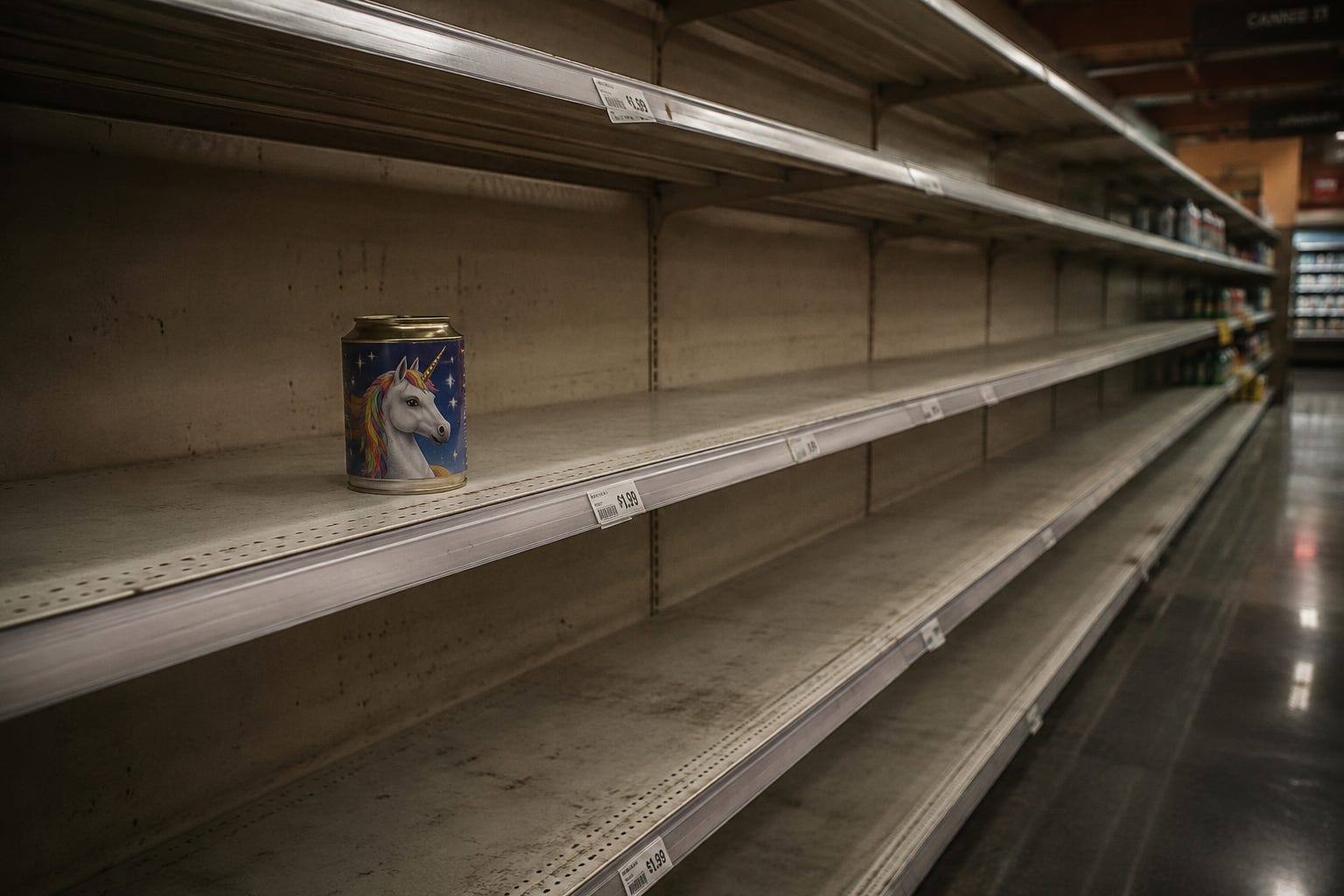
Last week I watched a woman nearly enter a spiritual crisis because the card reader at the grocery store stopped working.
Not forever.
For six minutes.
Six minutes without access to the invisible digital abstraction we all collectively pretend is reality and suddenly everyone looked like Victorian villagers confronting electricity for the first time.
And honestly? Respectfully? Same.
I don’t say this from some superior mountaintop of preparedness. I once forgot a password I created myself fifteen minutes earlier and had to sit quietly in existential reflection about the fragility of civilization.
But lately I’ve been thinking about dependency.
Not in the moralized bootstrap sense.
Not “rugged individualism.”
Not apocalypse cosplay by men named Todd who own fourteen tactical flashlights and describe beans as “protein units.”
I mean actual dependency.
The kind we rarely notice because modern infrastructure is designed to feel like nature.
Water comes out of the wall.
Food appears under fluorescent lighting.
Medicine arrives in little orange containers.
Gas stations work.
The internet exists.
Your phone charges.
Supply chains hum softly in the background like industrial whale song.
Until they don’t.
And increasingly, sometimes, they don’t.
Not dramatically.
Not movie-style.
Just enough to expose how thin the membrane really is.
A delayed shipment.
A weather event.
A power outage.
A banking glitch.
A pharmacy shortage.
A wildfire.
A fuel spike.
A cyberattack.
An overwhelmed system quietly shrugging in real time.
The thing is, I’m not actually interested in collapse fantasies.
Most collapse content feels trapped between two extremes:
bunker nationalism with dehydrated beef packets
nihilistic doomscrolling with better aesthetics
Neither feels particularly alive to me.
Because for many people, “collapse” isn’t hypothetical.
Some communities have already been living inside fractured systems for generations:
medical abandonment
housing precarity
food insecurity
climate disaster
institutional betrayal
economic instability
social fragmentation
So this isn’t really about “the end of the world.”
It’s about interruptions.
And more importantly:
What capacities remain when systems become unreliable?
That question keeps following me around.
What if your debit card stopped working?
What if fuel became scarce?
What if grocery shelves got weird for a month?
What if the internet disappeared for three days and half the population immediately lost access to both navigation and emotional regulation?
What if your community mattered more than your productivity?
What if preparedness had less to do with fear and more to do with relationship?
So I started building something called What If?
Not a prepper manual.
Not a guide to becoming emotionally attached to canned soup.
More like:
a field guide for staying human inside unstable systems.
Practical things, yes:
water
food
communication
first aid
backup power
repair skills
local resilience
But also:
nervous system regulation
conflict de-escalation
mutual aid
grief
adaptability
interdependence
knowing your neighbors
learning how not to become cruel under pressure
Because historically speaking, humans survive through cooperation far more often than domination fantasies.
Honestly, I suspect the most important survival skill may be:
being someone other people still want around during difficult times.
Not because you own seventeen generators.
Because you know how to:
share
repair
stay calm
improvise
listen
cook something edible from almost nothing
help without controlling
remain psychologically flexible
Civilization has outsourced so many basic capacities that even mild disruption now feels apocalyptic.
Most of us don’t need to become survivalists.
But we may need to become more relationally and materially literate than the current system requires.
That feels less like paranoia and more like remembering.
So this is the beginning of What If?
A growing collection of practical guides, reflections, skills, questions, and community resources for people who want to prepare without disappearing into fear.
Preparedness without paranoia.
Resilience without machismo.
Humanity without illusion.
The first free guide is now up on the website.
And honestly? Even if society holds together beautifully for the next hundred years, learning how to depend on each other a little better still seems like a worthwhile experiment.
These resources are free because I believe they should be.
Access to practical knowledge, community resilience, and collective preparedness should not belong only to people with disposable income, land, or the luxury of certainty.
At the same time, I’m one autistic mother trying to survive inside the same unstable systems many of us are navigating together. I’m currently unemployed, building this work with limited resources, and doing my best to support both my family and the communities I care about.
So if this work helps you and you’re financially able to contribute, you’re welcome to pay what you can.
And if what you can pay right now is nothing at all, that is genuinely okay too.
No guilt. No scarcity performance. No proving your worth.
Just people helping hold each other up where we can.
I really love where you are going with this. Thank you for writing and sharing so generously!
Thanks Sher. Getting to the heart of the matter - you've done it again! That's what we need without knowing we need it. I like to recognize all the invisible ways I am supported. It reduces the shock if they disappear and reminds me that I am not in this alone.